

Funny lemur facts might explain why your family dinner table occasionally resembles a wildlife documentary. Have you ever looked around at your household and wondered whether you accidentally adopted a troop of wild animals?
One child is guarding the last dinner roll like it’s a national treasure. Another is making mysterious noises from the other end of the table. Someone is arguing about whose turn it is to wash the dishes, and the family dog is conducting an unauthorized inspection beneath everyone’s chairs.
Meanwhile, Dad is wondering whether the zoo offers a family exchange program. Welcome to family life, where the difference between a civilized household and a wildlife documentary is occasionally nothing more than indoor plumbing.
Fortunately, nature has provided the perfect comparison: the lemur.

Funny Lemur Facts: Meet Madagascar’s Original Class Clown
Lemurs are primates found naturally on Madagascar, the island nation off Africa’s southeastern coast. With their expressive eyes, remarkable tails, and occasionally ridiculous behavior, they look like animals designed by a committee that couldn’t agree on the final product.
“Give it the eyes of an owl!” suggests one committee member. “The tail of a raccoon!” adds another. Someone demands the jumping ability of a kangaroo, while the final member insists on the personality of a teenager who just discovered energy drinks.
Somehow, the finished product works.
There are more than 100 recognized lemur species and subspecies, depending on the classification system. They range from the tiny mouse lemurs to the considerably larger indri. While lemurs come in many shapes and sizes, several species have behaviors that make human family life look suspiciously familiar.
The Ring-Tailed Lemur: CEO of the Sunbathing Department
Ring-tailed lemurs have mastered something most working adults can only dream about: sitting around in the sunshine while looking important. These animals regularly sunbathe with their arms spread and bellies facing the warmth.
Picture your stepdad reclining in his favorite chair on Saturday morning, coffee in hand, wearing slippers that should have been retired during the previous presidential administration. Now add a striped tail, and congratulations! You’ve discovered the family lemur.
Of course, ring-tailed lemurs have a legitimate reason for their behavior. Sunbathing helps them warm up after chilly mornings. Dad’s explanation, however, is considerably less scientific: “I’m resting my eyes.”
Which is remarkable, considering his resting eyes are producing sounds resembling a chainsaw struggling through a redwood.
The Great Lemur Stink Fight
Here’s a wildlife fact that sounds completely fabricated but isn’t. Male ring-tailed lemurs sometimes engage in stink fights. They rub scent secretions onto their tails and wave them toward rivals during confrontations. That’s right. Instead of throwing punches, they essentially fight by making themselves smell worse.
Somewhere, a teenage boy is reading this and thinking, “Finally, a sport I can dominate.”
Parents of adolescent boys may already recognize this behavior. You’ve entered your stepson’s bedroom. The windows are closed, dirty socks occupy several locations, and a half-eaten sandwich has apparently developed its own ecosystem.
You ask, “What is that smell?” He replies, “What smell?” At that moment, you realize he’s not being evasive. He’s evolved beyond noticing it.
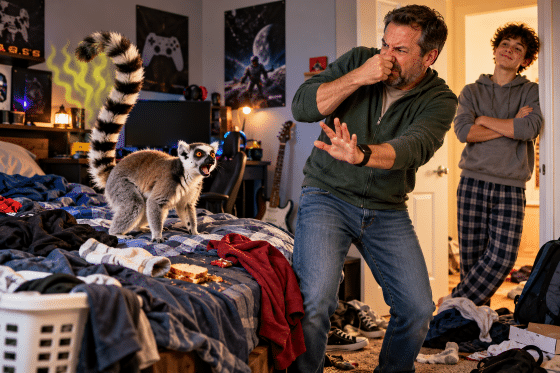
The lemurs would be impressed.
Who’s in Charge? Ask the Ladies
In ring-tailed lemur society, females generally dominate males. Yes, you read that correctly. The females usually get priority access to food and can displace males during social interactions. The males, meanwhile, have apparently decided survival depends on knowing when to move out of the way.
Sound familiar? At home, the stepdad announces, “I think we should rearrange the living room.” His wife replies, “I’ve already ordered the furniture.”
Meeting adjourned.
Of course, healthy human families thrive on mutual respect, shared decisions, and teamwork. But even the most confident stepdad occasionally discovers a family decision was finalized before he knew a meeting had been scheduled.
The ring-tailed lemur understands. Sometimes leadership means knowing when to surrender the remote.
The Sifaka: Madagascar’s Sideways Dance Champion
If you’ve ever seen a sifaka lemur moving across open ground, you’ve witnessed one of nature’s greatest comedy routines. These lemurs are superb leapers in trees. On the ground, however, some sifakas move sideways with their arms raised, hopping in a manner resembling an enthusiastic dance performance.

Imagine someone trying to cross a room while simultaneously avoiding hot lava, invisible furniture, and an angry goose. Now imagine your stepchild doing the same thing because the kitchen floor was just mopped.
“Don’t walk on that floor!” you shout. “I’m not walking! I’m jumping!” comes the reply. Technically correct, but entirely unhelpful.
Sifakas aren’t actually dancing for entertainment. Their unusual movement helps them travel on the ground despite bodies specialized for vertical climbing and leaping. Still, if Madagascar ever launches a televised dance competition, the sifaka deserves a guaranteed spot in the finals.
Preferably against an uncle at a wedding reception.
Lemur Family Meetings: Everybody Has Something to Say
Many lemurs are social animals that communicate through vocalizations, scent signals, and body language. Some species have elaborate calls that help group members stay connected. Human families have developed similar communication systems, although their effectiveness remains questionable.
There’s the familiar “Dinner’s ready!” call, the less successful “Who left the refrigerator open?” call, and the universally ignored “Please turn that music down!” call.
Then there’s the stepdad’s most mysterious communication challenge. He asks, “Who ate the leftovers?”
Silence.
He repeats the question. More silence. The dog leaves the room.
Finally, someone answers, “I thought nobody wanted them.” This is particularly interesting because the leftovers were labeled DAD’S LUNCH – DO NOT EAT. Apparently, the label was interpreted as a serving suggestion.
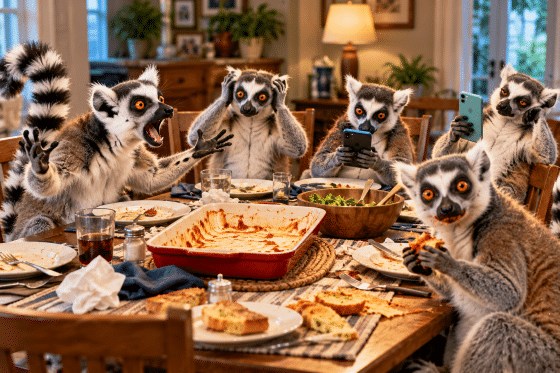
At least lemurs don’t have to contend with teenagers who can communicate through 47 emojis but can’t answer a simple question about the missing lasagna.
The Family Grooming Department
Social grooming plays an important role in many lemur species. It helps maintain relationships and remove dirt and parasites. Some lemurs even have specialized lower teeth forming a toothcomb used for grooming.
Human families have their own version, although it usually involves unsolicited fashion advice. There’s “Your hair is sticking up,” followed by “There’s something on your shirt,” and the always popular “Did you brush your teeth?” Occasionally, parents encounter more puzzling situations, such as “Why are you wearing two different shoes?”
And then there’s the timeless parental favorite: “You’re not going out looking like that.”
The teenager looks down at an outfit that cost more than the monthly electric bill and asks, “What’s wrong with it?” The parent pauses, searching for words acceptable in polite society, before finally asking, “Where’s the rest of it?”
Unlike lemurs, humans have invented mirrors, hairbrushes, washing machines, and entire industries dedicated to personal appearance. Yet somehow, we still leave the house with toothpaste on our shirts.
The Real Wild Animals Might Be Us
After studying lemurs, one thing becomes clear: these animals aren’t nearly as ridiculous as they first appear. Their behaviors serve practical purposes. They communicate, establish social relationships, protect their territories, and cooperate within groups.
Humans, meanwhile, spend 20 minutes looking for sunglasses already sitting on top of our heads. We argue with GPS directions, open the refrigerator six times expecting new food to materialize, and purchase expensive exercise equipment only to use it as a clothing rack.
Who’s really the wild one?
At least lemurs don’t pay for gym memberships they never use.
What Lemurs Can Teach a Blended Family
Behind all the laughter lies a useful reminder. Like lemur groups, blended families contain different personalities, competing needs, and occasional disagreements. One family member needs quiet, another needs attention, and someone wants independence while someone else just wants the television remote.
A stepdad doesn’t have to control every interaction or win every disagreement. Sometimes the wisest response is patience, a little flexibility, and the ability to laugh when things don’t go according to plan. After all, strong families aren’t built by eliminating every awkward moment. They’re built by learning to navigate those moments together.
And if your stepson leaves another mysterious sandwich under his bed? Remember the lemur, open a window, and whatever you do, don’t start a stink fight.
Final Thought: The next time your household feels like a wildlife documentary, remember that even Madagascar’s wildest residents have figured out how to live in groups. They just haven’t had to negotiate screen time.
Keep the Family Fun Going!
Whether your household resembles a well-organized lemur troop or a wildlife documentary gone wrong, laughter and shared adventures can bring everyone closer. Fortunately, you don’t have to travel to Madagascar to create unforgettable family memories! Discover some seasonal inspiration in our article, Fall Family Fun: Activities for the Whole Family, and make the most of this colorful season together.